
Author Archives: Mark

The Humor of Socrates in the Euthydemus

Socrates is a funny guy. Yes, he is serious, but he is never solemn. You can be funny and serious at the same time. This dialogue, the Euthydemus, is a fine example.

First a little background: Socrates believes that Athenians are being poorly served by the Sophists, a group of self-proclaimed teachers of rhetoric (the art of political, legal, and philosophical persuasion). To him, Sophists pretend knowledge they do not have, and take money to “educate” those who know even less, but who leave their “teachers” thinking they know.

Sophists love to make speeches. They do not want to engage in the discipline of focused questioning and answering. They love to change topics, play with the ambiguities of language, entrance their listeners. They do not want to be shown that their words lack meaning.

Good education requires mental effort. When Socrates engages in conversation, he is looking for someone willing to exert themselves mentally. Someone willing to have humility and goodwill, someone willing to think through what they believe and change if necessary, someone willing to have the patience to focus on one thing at a time and come to an understanding of what that one thing means.

This is dialectic, a dialogue between two persons of goodwill who are able to exercise the patience, discipline, and mental focus and energy to clarify their understanding of a topic.

Rhetoric is the opposite. It’s not about coming together into truth. It’s about exploiting the ambiguities of language to gain the upper hand.

Dialectic is about acquiring knowledge.

Rhetoric is about winning.

In the Euthydemus, Socrates tells Crito about an attempt at dialectic he had with two brothers of a foreign land, Euthydemus and Dionysodorus. They are self-proclaimed Sophists and teachers of Eristic, that is, fighting with words. They used to teach fighting with arms and armor. But they have learned from teachers of rhetoric, and for a price will teach anyone how to fight with words, how to win any argument.

Plato here immediately establishes the humor of the situation. Here are two young men who are not very bright. They think they can move easily from teaching fighting with arms and armor to fighting with words. You see, they realize that rhetoric is the Next Big Thing, the new money-making business, and one does not have to break a sweat to charge a fee and teach verbal swordplay.

This is like someone who thinks they can become a rocket scientist because they have fired rocket launchers!

These brothers use Eristic to exploit the logical ambiguities of words. Here’s an example of how the brothers play off the ambiguity of the verb is. They are talking about Socrates’ father, Sophroniscus:

Yes, I said, he is my half-brother, the son of my mother, but not of my father.

Then he is and is not your brother, said Dionysodorus.

Not by the same father, my good man, I said, for Chaeredemus was his father, and mine was Sophroniscus.

And was Sophroniscus a father, and Chaeredemus also?

Yes, I said; the former was my father, and the latter his.

Then, he said, Chaeredemus is not a father.

He is not my father, I said.

But can a father be other than a father? Or are you the same as a stone?

I certainly do not think that I am a stone, I said, though I am afraid that you may prove me to be one.

Are you not other than a stone?

I am.

And being other than a stone, you are not a stone; and being other than gold, you are not gold?

Very true.

And so Chaeredemus, he said, being other than a father, is not a father?

I suppose that he is not a father, I replied.

For if, said Euthydemus, taking up the argument, Chaeredemus is a father, then Sophroniscus, being other than a father, is not a father; and you, Socrates, are without a father.

Can you see what the brothers are doing here? They are not interested in an honest search for truth. They are using verbal wordplay and the ambiguity in the nature of the verb is to come to illogical conclusions.

The verb is can be used in two ways:

1) Identity: Something is. “He is Socrates.”

2) Relation: Something is in relation to something else. “He is a father.”

The word father describes a relation, not an identity. An identity applies in every case.

A relation only has meaning in terms of what it is related to, and it does not apply in every relation (in every case). But the brothers play on the word as if it were an identity.

And they can play with language in this silly way all day.

To Socrates and Plato, any idiot can use verbal wordplay to create an incoherent mish-mash of meaninglessness.

A Sophist says what he thinks other people will believe rather than what is true.

Socrates says what he thinks is true even though other people won’t believe it.

A Sophist trains others in a skill for money.

Socrates educates because it is good for people. He does not accept money.

Training is for workers and slaves.

Education is for free people.

Socrates then is a true educator in the original sense: Educare means “to lead people out of.”

For Socrates, true education leads people out of the slavery of false beliefs into the freedom of the truth.

To Socrates, Euthydemus and Dionysodorus are so idiotic that they are only dangers to themselves. Socrates plays with them and is gentle with them. He indulges humorously with them.

But with other Sophists, like Protagoras and Gorgias, Socrates is not so gentle.

Because they should know better.

*****
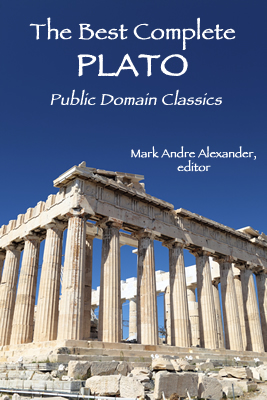
Cover-Plato-3-100

*****


The Esoteric in Plato

According to professor Arthur M. Melzer, in his 2014 book Philosophy Between the Lines: The Lost History of Esoteric Writing, until the 19th century philosophers were well-known to have provided both exoteric (public) and esoteric (private) versions of their philosophy.

Aristotle was known for this dual communication in his lectures, and Proclus said of Plato that since it was unbecoming to speak of the most divine of dogmas before the multitude,

Plato himself asserting that all these are ridiculous to the many, but in an admirable manner are esteemed by the wise. Thus also, the Pythagoreans said, that of discourses, some are mystical, but others adapted to be delivered openly. With the Peripatetics likewise, some are esoteric, and others exoteric; and Parmenides himself, wrote some things conformable to truth, but others to opinion; and Zeno calls some assertions true, but others adapted to the necessary purposes of life.

Professor Melzer explains that classical and medieval writers understood that if they spoke openly of their beliefs they would suffer consequences. Some, like Pythagoras and Socrates, wrote nothing. Others, like Plato and Aristotle, wrote but may have conveyed the esoteric only through oral teachings to selected students.

But there were also those who wrote exoterically with the esoteric writings hidden “between the lines” through hints and insinuation, and perhaps through coded language. They wrote in a multi-level way.

Saint Augustine in the fourth century A.D. in one of his letters believed that the pure stream of philosophy should be available for only the few and kept away from the common herd. “I think that that art of concealing the truth is a useful invention.”

An Arabic philosopher in the tenth century, Al-farabi, wrote a commentary on Plato’s Laws in which he states:

Wise Plato did not reveal all his knowledge to all people. He used symbols and riddles, wrote in veils and made the text a challenge, so that knowledge would be protected from the undeserving who would change it, and from those who, not knowing its value, would use it poorly. He was correct to do this. Once he became renowned for this practice, he would occasionally state a topic more openly and literally; but some readers still assume he is being symbolic or obscure, intending something different from the literal. This idea remains as one of his greatest secrets. Only those trained in that art of two-level and secret meanings will understand Plato.

Although my purpose here is not to pretend to know such two-level and secret meanings, I’ve included some Neoplatonic writings and commentaries, primarily through Thomas Taylor, so that the reader may get a glimpse of what may be hidden.

The Two Traditions

There are essentially two major approaches to the inquiry into Truth: one tradition, primarily Eastern, of learning directly from a master or guru, through direct experience and revelation; and another tradition, primarily Western European, of intellectual philosophical inquiry through argument and reasoning.

Perhaps ironically, Plato’s dialogues embody both. Socrates himself did not believe in writing down his teachings. He believed that writing down philosophy resulted in a loss of memory, a kind of forgetting that undermined a moral culture by letting a person become lazy. For when something is written, you do not have to remember it, or exercise your own mind and imagination to properly own it yourself.

He also faulted writing because you cannot question it, like you can a person, and expect an answer. He explains why in the Phaedrus:

I cannot help feeling, Phaedrus, that writing is unfortunately like painting; for the creations of the painter have the attitude of life, and yet if you ask them a question they preserve a solemn silence. And the same may be said of speeches. You would imagine that they had intelligence, but if you want to know anything and put a question to one of them, the speaker always gives one unvarying answer. And when they have been once written down they are tumbled about anywhere among those who may or may not understand them, and know not to whom they should reply, to whom not: and, if they are maltreated or abused, they have no parent to protect them; and they cannot protect or defend themselves.

However, we cannot help but be grateful that Plato wrote what Socrates did not.

The idea that Socrates sought to impose his ideas of Truth, Justice, and Virtue on others is contradicted by him in the Theaetetus, among others, where he attributes to his inner divine guide a restriction against his bring forth his views:

Well, my art of midwifery is in most respects like theirs; but differs, in that…the triumph of my art is in thoroughly examining whether the thought which the mind of the young man brings forth is a false idol or a noble and true birth. And like the midwives, I am barren, and the reproach which is often made against me, that I ask questions of others and have not the wit to answer them myself, is very just—the reason is, that the god compels me to be a midwife, but does not allow me to bring forth. And therefore I am not myself at all wise, nor have I anything to show which is the invention or birth of my own soul, but those who converse with me profit.

So in a very direct sense, Socrates is in engaging in a Master/Student pursuit where the Student discovers the way himself with the help of the Master. Plato, on the other hand, wrote and schooled and set the course for the Western tradition of philosophy. As Alfred North Whitehead said:

The safest general characterization of the European philosophical tradition is that it consists of a series of footnotes to Plato.


*****

from the Editor’s Introduction: The Best Complete Plato

*****

Cover-Plato-3-100

*****


The Language of Plato

We live in an age of simple sentences. Some may say we have moved into an age of simple words, or even simple letters and numbers where smartphone texting rules all.

Language embodies consciousness, and simple sentences embody simple states of consciousness. The ancient Greeks, and philosophers for the next 2,500 years after, expressed complex thoughts requiring complex sentences.

Today’s readers often stop reading when faced with complex sentences that can run an entire paragraph, not realizing that to exercise one’s mind with such complex sentences creates the same kinds of opportunities that exercising one’s body with complex exercises creates.

The mind benefits from development as much as the body.

The ancient Greek language allowed for ever-increasing complexity of thought. Thinkers could command an array of language tools to develop complex and subtle relationships among ideas, both coordinate and subordinate.

Here’s an example of a paragraph that expresses several ideas as twelve simple sentences, leaving the reader with a set of simple, coordinate ideas:

A polluted soul is impure at the time it departs. It is the companion and servant of the body. It is in love with the body. It is fascinated with the body and its desires and pleasures. The soul sees the body as truth. Such truth exists only in touch, sight, and taste. The body is used for lusts. Such a soul is accustomed to hate and fear. That soul avoids the intellectual. The body’s eye views the intellect as dark and invisible. The intellectual can only be attained by philosophy. Will such a soul depart pure and unalloyed?

Now here is the same set of ideas expressed by Plato in the Phaedo in a single sentence. Notice the subordinate and relative relationships established. Notice the subtlety of expression that he accomplishes.

But the soul which has been polluted, and is impure at the time of her departure, and is the companion and servant of the body always, and is in love with and fascinated by the body and by the desires and pleasures of the body, until she is led to believe that the truth only exists in a bodily form, which a man may touch and see and taste, and use for the purposes of his lusts—the soul, I mean, accustomed to hate and fear and avoid the intellectual principle, which to the bodily eye is dark and invisible, and can be attained only by philosophy—do you suppose that such a soul will depart pure and unalloyed?

For new or inexperienced readers of Plato, and the commentaries of commentators and translators who follow him, please do not be put off by the complexity of the sentences.

Stretch yourself; exercise your mind. Although initially wearing, like physical exercise, your mind will appreciate the expansion given it by your continuing efforts.

One great value of eliminating all of the in-text editorial comments, citations, and annotations is that you can grapple directly with Plato and build valuable mental muscles without distraction.

For in reality, Plato is not that difficult. The exercise equipment is simple. It’s the set of exercises and regimen that challenges.

Plato is also rewarding because he reveals how so much of current thought is a repeat of thought 2500 years ago. If you are interested in Western philosophy, and to some extent Eastern philosophy as seen in Socrates’ voice, start with Plato.

Although each dialogue provides introductions by the translators, I recommend the reader tackle each dialogue first. Why spoil a first reading with someone else’s opinion? Sometimes a fresh mind sees things others have missed.

Also keep in mind that, although Plato writes seriously, his writing is filled with humor. Socrates is a funny guy. He is constantly making jokes and sly ironic comments. Plato’s humor may seem to lapse more in some of the late dialogues, but it is always there, especially when Socrates is on the scene.

So read these dialogues with good humor.

Enjoy the journey!


*****

from the Editor’s Introduction: The Best Complete Plato

*****

Cover-Plato-3-100

*****

Is Socrates’ Voice Different from Plato’s Voice?

Socrates never talks directly to us. So many will say that we can never trust that anything written by Plato is actually in Socrates’ voice.

I disagree. As you read, you may notice that there are at least two voices coming through Plato’s writings. Admittedly, it is all Plato. However, Socrates’ own voice is distinct, especially in the early dialogues.

The later dialogues do not even have Socrates as a character, so you can readily assume that the voice is primarily Plato’s, particularly in the person the Stranger or Guest.

But it is worthwhile to identify Socrates’ voice. How to tell the difference?

Here is my opinion:

Socrates is interested in individuals who are actually present before him in the moment. He is not concerned with those not present. Socrates was the master who sought to help others become free of false opinions. He was less interested in societal change, except to the extent where individuals let go of false opinions, a release from rhetorical illusion.

Plato, on the other hand, was the student who went on and attempted to codify Socrates, and use him as a mouthpiece for a more artistic purpose. Plato tended towards creating a plan for others, a planned moral State that reflected what he thought was ideal. Part of that plan included helping individuals become most moral through a planned education.

In my opinion, where Socrates comes through most is where he clearly advocates for individual choice, morality, and freedom to choose. He held greater concern about the health of each individual Soul rather than the health of society.

It appears he assumed that by helping each individual Soul, society by extension would improve.

Socrates believed in individual change from the inside out, with society changing as individuals changed. In other words, society changes bottoms up as you give individuals the proper education.

Plato came to believe more in change from the outside in, from laws and central control. His approach appears to be more from the top down for societal change, forcing people into an ideal, although there is evidence that he later was disillusioned with this approach.

His voice comes through more in ivory-tower planning and directing the lives of others. That is why so many elite modern-day planners have held Plato close, sometimes with disastrous results, as in the case of Joseph Stalin and other current societal planners.

Plato’s early writings are more Socratic. His later writings, particularly those that leave out Socrates, are more Platonic.

But I leave it to you to determine your own vision of each. Many will disagree with me. And in ten years, after reading Plato two or three more times, I may change my mind and embrace a new and completely opposing view.

It is a worthwhile journey.

*****

from the Editor’s Introduction: The Best Complete Plato

Cover-Plato-3-100

Plato the Artist: Seeing the Dialogues as a Whole

You have to read Plato two or three times before you can read Plato for the first time.

Seeing Plato dialogue by dialogue is a fine start. But a new world of wonder opens up when you see the dialogues as an artistic whole, a view that only comes about when you know them well enough to sense how they play off each other.

Here is an example:

In the Apology and the Phaedo, we learn how the citizens of Athens regarded Socrates as a sophist, a mere manipulator of words, and as such condemned him to death. Socrates argues persuasively that he is not a sophist, not a mere exploitive rhetorician. His dialectical approach is clearly educative and improves those who come into contact with him.

In the Protagoras, we get a look at a bunch of real sophists gathered together in the home of Callias. One of Socrates’ students wakes him before the sunrise so that they can go to Callias’s home and talk with the famous sophist and intellectual Protagoras.

Socrates firsts says that they can’t go so early in the morning. Instead, they should walk around first until the sun is up. Thus, as in so many dialogues, we get a journey motif.

It’s important to pay attention to the dialogues where journeys are involved. As you may come to realize, Plato is setting up Socrates as the new hero of the Greeks, replacing Homer’s hero Odysseus.

Socrates wants to arrive when the sun is up. The sun is a motif across dialogues representing the realm of the forms, or true knowledge. (See in the Republic the myth of the cave.)

While they walk, they engage in conversation about, What is a sophist? What do you want to learn from a sophist? Socrates educates his student through dialectic, but does not charge a fee.

This journey illustrates that Socrates engages in true education and improvement, but not as a profit as do the sophists.

First we get a view of the Socratic way of educating. Later we get a contrasting view of how the sophists educate.

So they reach the home of Callias and are met by a eunuch. The eunuch appears overwhelmed by the presence of sophists, who make long speeches and do not seem to listen to each other. The eunuch sees Socrates and his student and turns them away, saying that there is no more room for more sophists. Socrates replies that they are not sophists.

Here we see a glance at the Apology and the Phaedo. The eunuch, like the citizens of Athens, cannot tell the difference between a sophist and a real educator.

And you can imagine why Plato would allude to the Athenians being philosophical eunuchs.

Here’s is an example from the Republic, which contains ten dialogues in Books (as divided by scholars), and is so large that one must keep in mind that there is a larger artistic vision here playing out symbolically:

In Book VIII, Plato reveals the five kinds of souls, four of which are harmful and which relate to the four kinds of bad governments. (In the Republic Plato explores the best form of government in his view, which is the government of Philosopher Kings.)

From better to worse the bad governments are: Timocracy, Oligarchy, Democracy, and Tyranny.

The alert reader will also recognize that the four kinds of bad government are represented by those who question Socrates: Glaucon (Timocracy), Adeimantus (Oligarchy), Polemarchus (Democracy), and Thrasymachus (Tyranny). Socrates of course represents the government of Philosopher Kings.

And the alert reader will also see that as the Republic progresses, each questioner moves up the ladder. For example, in Book I Thrasymachus clearly advocates for Tyranny, but then in the beginning of Book V, after much silence, he agrees with the others and asks that Socrates continue and discussion the education of women (where Socrates reveals himself to be the first feminist).

In other words, Thrasymachus moves from being the Tyrannic Man and becomes the Democratic Man, a step up on the journey to the Philosopher King.

Plato is famous for his Theory of Forms, which is articulated most fully in the Republic. Many people could read the Republic and think Plato advances the theory and design of the state as fixed Platonic doctrine. But in a later dialogue, the Parmenides, Plato offers a powerful critique of his own theory, one that clearly plagues Plato the rest of his life. He was an honest philosophy, honest enough to acknowledge the critical weaknesses in his own theory.

You do not finish reading all of Plato’s dialogues knowing the answers. But you do finish having developed stronger mental processes of approaching questions and truth in a way that creates a more healthy intellectual and spiritual understanding.

And you achieve a high view of artistic truth and beauty.

*****

from the Editor’s Introduction: The Best Complete Plato

Cover-Plato-3-100

Why Bother with Plato?

With Plato, the tradition of critical Western speculation begins in the historic person of Socrates, a fifth-century B.C. Greek sage in ancient Athens during that city’s renaissance in democracy, art, and culture.

The primary sources for knowing Socrates are his student Plato and an historian and soldier, Xenophon. Others wrote in lighter ways about Socrates, including the comedic writer and his contemporary Aristophanes, whose comic play Clouds ridicules Socrates as a sophist and verbal pretender. But only Plato’s dialogues sustain a level of artistry that makes them singular and unique in the history of art.

The historical and cultural environment is critical for understanding Socrates and Plato. Although that history and culture is too much to cover for this introduction, I will mention two key influences.

First is the importance of mathematics, in terms of geometry and music. Socrates was strongly influenced by an understanding of Pythagorean mathematics, which highlighted the divine character of number, geometric forms, and musical intervals. Pythagoras, like Socrates, did not write down his philosophy. He led a secret group of followers in a religious application of mathematics to understand God and the orderliness of creation. He believed in reincarnation and the immortality of the Soul. Pythagoras stands as a permeating influence on Socratic and Platonic philosophy.

Second in importance to Socrates are the Ionian physicists, whom he opposed fiercely. These physicists included Thales, Heraclitus, Anaxagoras, Anaximander, Anaximenes, Archelaus, and Diogenes of Apollonia. They created a materialistic, rationalistic explanation for nature that precluded the need for myths, gods, and religious meaning. Nature was merely material that was in constant chaotic change or flux, a meaningless explanation for sense perception. It had no ultimate purpose.

Socrates opposed these physicists because he saw how these naturalistic philosophies created a kind of skepticism that undermined language and law, forming a foundation for political sophistry and manipulation through language, which ultimately removed the need for people and societies to have a moral character.

Socrates believed in political and moral order, and Plato’s dialogues are works of art designed to make the case for political and moral order, both of which are connected to healthy individuals and communities.

In Plato’s view, Athens killed the most just Athenian, Socrates, who least deserved punishment. They lacked judgment and the ability to make wise decisions, both in killing Socrates and engaging in the Peloponnesian Wars, which resulted in the collapse of Athenian democracy.

So Plato set out to create works of art to address the ability of people to overcome ignorance and make better decisions. And he did this by following Socrates, who where possible avoided relying on dogma.

How?

The early dialogues tend to be aporetic, meaning that they end without a resolution. Socrates is not trying to get people to accept his definition of virtue, knowledge, justice, and so on. He does not even offer a definition. He is trying to get his partner in conversation (through dialectic as opposed to rhetoric) to think for himself: to think through the definitions, the weaknesses and contradictions, to become aware of how the mind holds false opinions, and is fundamentally ignorant in knowing truth.

With the middle dialogues, such as the Protagoras and Gorgias, Socrates begins to offer his own understanding of definitions. His purpose is to attack sophistry directly.

Plato’s later dialogues, such as the Laws, drop the character of Socrates altogether, and present a shift from pure dialectic (one to one) to rhetoric (one to many).

Plato is a poet who writes. Socrates is a sage who writes nothing. Plato, as a poet like Shakespeare, writes dramatically and symbolically. Nothing is wasted. Every line is important. In fact, I would say myth and poetry are more important in Plato than logic.

Logical analysis of Plato has great value, but in the last century, much has been lost in recognizing the poetic and mythic value of the dialogues. If you read a portion of a dialogue and think it is of lesser value than another that you think has the real meat of the conversation, you are missing out on Plato’s art.

The way a dialogue is framed at the beginning tells the reader something about the dialogue itself. A digression may actually be the central purpose of the dialogue.

For example, in the beginning of the Republic, Socrates says:

I went down yesterday to the Piraeus with Glaucon the son of Ariston, that I might offer up my prayers to the goddess; and also because I wanted to see in what manner they would celebrate the festival, which was a new thing.

If you take Plato at face value, you read the beginning of this dialogue as something merely descriptive. But Plato is an artist, a poet. Beginnings are important to Plato, and they set a symbolic tone.

For example, whenever you see in Plato someone ascending or descending, you can bet that Plato is symbolically illustrating where the person is going on the philosophical scale.

Later in the Republic, as the discussion on Justice heats up, Plato has Glaucon talk about the story of Gyges:

According to the tradition, Gyges was a shepherd in the service of the king of Lydia; there was a great storm, and an earthquake made an opening in the earth at the place where he was feeding his flock. Amazed at the sight, he descended into the opening…

Gyges finds a ring that makes him invisible. He uses his new power to kill the rightful king and take over the kingdom. Glaucon argues approvingly that anybody would do as Gyges had done.

Like Gyges, Glaucon has descended on the philosophical scale.

Plato’s artistry continually illustrates the difference between seeming and being. Like Shakespeare, Plato is concerned with seeming, which is the domain of rhetoric or public speaking to persuade a group, and being, which is the domain of dialectic or one-on-one conversation to agree on the truth.

Socrates does not want to tell the truth. Socrates wants the persons he talks with to state the truth themselves. (Shakespeare as a dramatist shows the seeming, but as a poet he reveals the being. The Merchant of Venice on stage seems to be anti-Semitic, portraying a bad Jew, but to the reader paying attention to the poetry and symbolism of the play, Shakespeare reveals the being of the Christian characters, who in their un-Christian treatment of Shylock, reveal their true hypocritical selves. Have you ever noticed what the opening words of each of the major Christian characters have in common?)

Plato, especially in the person of Socrates, does not want to tell you what to think. His dialogues are artfully designed to exercise how you think. Some of Socrates’ partners in conversation are lazy and do not want to exercise their minds, which often brings the dialogue to an end without a resolution. Meno, in the dialogue of that name, is lazy and does not want to think. He wants Socrates to tell him the answer. He is a bad student.

But sometimes Socrates has a good student, like Theaetetus, in the dialogue of that name, who exercises his mind strongly and thus allows Socrates to engage at a different level of conversation.

Socrates wants to push you towards knowledge by expanding the domain of your ignorance. For he knows what all sages know: you must make room for real knowledge by letting go of false knowledge.

*****

from the Editor’s Introduction: The Best Complete Plato

Cover-Plato-3-100

Socrates’ Divine Inner Voice

Socrates often mentions that he is guided by a daemon, a kind of divine spirit, oracle, or “sign,” that takes the form of an inner voice or non-vocal nudge. The guide never tells Socrates what to do. It only indicates when Socrates is not to do something.

This distinction is important. One way to tell that a dialogue is spurious is if it has Socrates’ daemon tell someone else what to do.

Socrates learned over time to listen to this inner divine voice. He acted in service to it. Nothing that he does in his life is untouched by this inner divine voice.

He describes it in the Apology:

You have heard me speak at sundry times and in diverse places of an oracle or sign which comes to me, and is the divinity which Meletus ridicules in the indictment. This sign, which is a kind of voice, first began to come to me when I was a child; it always forbids but never commands me to do anything which I am going to do. This is what deters me from being a politician.

Later, he explains that the defense he is giving to the Athenian court has been approved by this inner divine voice.

Hitherto the divine faculty of which the internal oracle is the source has constantly been in the habit of opposing me even about trifles, if I was going to make a slip or error in any matter; and now as you see there has come upon me that which may be thought, and is generally believed to be, the last and worst evil. But the oracle made no sign of opposition, either when I was leaving my house in the morning, or when I was on my way to the court, or while I was speaking, at anything which I was going to say; and yet I have often been stopped in the middle of a speech, but now in nothing I either said or did touching the matter in hand has the oracle opposed me. What do I take to be the explanation of this silence? I will tell you. It is an intimation that what has happened to me is a good, and that those of us who think that death is an evil are in error. For the customary sign would surely have opposed me had I been going to evil and not to good.

Commentators throughout the centuries wonder at what it was that drove Socrates to be the Athenian gadfly, the devoted citizen and warrior, the one who chose poverty over charging his students or any who would listen to his one-on-one conversations.

This divine inner voice spoke inwardly to him, moving him to be the true hero of the Athenian people, being a corrective to their hubris. Along the way, Socrates became a true hero of the Greek people and western civilization; and he became so effective that they killed him for it.

Almost 500 years later, Plutarch wrote a dialogue on this daemon of Socrates. It is included in this anthology.

*****

from the Editor’s Introduction: The Best Complete Plato

*****

Cover-Plato-3-100

*****

Changing Your Life Is Like Kitchen Remodeling

One of the things that the Power of Positive Thinking crowd often fails to mention is that whenever you try to make a big change in your life, your life can sometimes enter a stage where it seems everything is falling apart.

When you want to take your airplane to a new altitude, put on your seatbelt because you may experience some turbulence on the way up.

Making a major change in yourself or your life is like kitchen remodeling.

You have your old kitchen. You’re content with it out of sheer habit.

Then one day you visit a friend who has remodeled their kitchen. New granite counter tops, fresh matching appliances, new tile floor. You decide to remodel your kitchen.

Unfortunately, the transition to the new vision or goal is not immediate. There is a dismantling period where your kitchen must be removed. You have a less than functional kitchen.

You enter a kind of Dark Night of the Soul.

A less-functional or gutted kitchen means hard times. And there is always danger that if the new vision hasn’t fully taken hold, you will hang on to the old kitchen rather than move forward into the new kitchen.

The new vision has to be stronger than
the current picture to get you to act.

This happens whenever you set a vision or goal and work to make it happen. The key again is that whatever goal you set, you must hold it strongly in mind.

If you hold the goal strongly in mind,
if you daydream about it and feel it,
you are more likely to achieve your goal.

Your enthusiasm for the new vision
carries you through the tough transition.

You inspire yourself with it continually, and sustain the vision and energy through the rough times. Your old “anchor points,” those fixed pictures that anchor your vision of reality, will get pulled up to make room for the new vision. You hold the vision in order to have the energy to carry your goal through to completion.

You want to become a chemical engineer. You are not one right now. But you know some chemical engineers, and their work fascinates you. You think you can be good at it and have fun with that kind of work.

So you hold a new vision of yourself that does not match your current picture. What do you do? You motivate yourself to go to school, do the work, get the degree, search for a job, go to interviews, accept a job offer, learn the job, grow in your new role. The vision manifests.

You have given up your old picture and adopted a new, more professional and experienced one.

The mind is easily distracted. Therefore, one has to work hard to keep the mind focused and disciplined. This is why people work with positive statements and affirmations.

from Creating Your Life

1. Creating Your Life thumb

The Nocebo Effect: Evil Twin of the Placebo Effect

Beware of the negative effects of false assumptions:

The Nocebo Effect

—In a 1970s study doctors diagnosed man with end-stage liver cancer. They told him he had just a few months to live. The patient died. An autopsy showed no cancer.

A —1992 study demonstrated that women believing they were prone to heart disease were 4-times as likely to die.

—In a 2009 study, participants were told they were given drugs with bad side effects. They were told the bad side effects for their particular drug, which was actually a placebo. They experienced burning sensations outside the stomach, sleepiness, fatigue, vomiting, weakness and even taste disturbances, tinnitus, and upper-respiratory-tract infection. These “Nocebo” complaints were not random; the side effects experienced were specific to the type of drug they believed they were taking.

Beware of Self-Fulfilling Prophecies. See more on the Creating Your Life channel on YouTube:

The Happy Pill: Would You Take It?

If the government were to offer you a free daily Happy Pill, would you take it?

A pill that would
remove all your worries,
relieve all your pain,
eliminate any possible suffering?

Would you take it?

And would you call yourself a happy person while on that pill?

If you are like most healthy people, you have an instinctive reaction against the idea of a Happy Pill.

Why?

Is it because you feel:

— Like you’re being controlled?

— That you are losing something valuable and essential?

— You’re somehow no longer a real human being if you take it?

— That your life would be more that of an animal or plant than a human being?

Many people look at all the pain and suffering in the world, and they want it to stop. They want everyone to be happy. And they believe everyone should be happy; otherwise, life is not fair.

Therefore, the Happy Pill would be a good thing, right?

No more pain, no more suffering.

The idea of a Happy Pill assumes something significant:

— That pain and suffering have no purpose, no value.

— That pain and suffering have nothing to contribute to a happy life.

— That a world without pain and suffering would be a better world.

Think about such a Happy-Pill world:

  • No one would find anything painful.
  • No one would know they made a mistake.
  • No one would know when they took a false step.
  • No one would feel the need to empathize with the pain of others, since no one would be in pain.
  • No one would need to grow or change.
  • No one would need to feel compassion for anyone else.
  • Everyone would be equal. Everyone would feel the same happiness.

Everyone would be in their
own little happy world
with other people all equally
in their own little happy worlds.

And we all know how important it is for all people to be equal, right?

Does this Happy Pill world sound like a real life to you?

Is this really the kind of world you want to live in?

From Sex and Romance

3. Sex and Romance thumb