Author Archives: Mark

Evil Dictionaries (Updated)

The genuine purpose of a dictionary is to preserve distinctions despite public misuse.

A good dictionary functions as a ruler, as a constant unit of measurement for meanings to help people acquire a flexibility and subtlety of language and thought, for deeper and common communications and expressions.

A good dictionary warns against such misuse.

An evil dictionary, on the other hand, will descend to affirming popular misuses, even to the point of deleting the original, correct usages. By evil, I mean that which breaks down structures and hierarchies that lead to greater freedom of thought, expression, and awareness.

Which word is correct usage for the following sentence?

“We expect his continual/continuous presence in class this month.”

“Continual” means repeated at intervals while “continuous” means non-stop. Therefore, continuous presence would mean he never goes home, night or day. This is a distinction worth preserving, but evil dictionaries will blur the distinction, calling them synonyms.

Evil dictionaries allow misuse to flourish and blur distinctions that are freeing. We live in an age that throws out hierarchies just for being hierarchies. Thus, many liberating structures are being reduced to rubble.

Manipulators of power want to blur the language, to keep people from using language specifically, clearly, and effectively because such people are easy to control. Clear and distinct definitions clarify reality, while unclear and ambiguous usage and misuse blur reality and keep people from seeing what is really going on. (“It depends on what the meaning of is is.”)

In other words, if I can get a blurred meaning into your imagination, you will not see past that implanted meaning. I can then get away with misdirection in reality, while you are blinded by the implant.

Let me give a politically manipulative example that you can use to immediately classify your dictionary. Look up the word inflation in its economic sense. If the definition given is only that inflation is “a general rise in prices,” then you have an evil dictionary. If your dictionary defines inflation as “an increase in the supply of currency (money or credit) that causes prices to rise”, then you have a good dictionary.

If your dictionary supplies both without warning you that the first usage is a popular misuse, then you have a partially evil dictionary. You see, there is a profound difference between the two definitions. Inflation is not “rising prices.” Inflation causes prices to rise.

There are people who want you to believe that inflation is merely rising prices in order to disguise the fact that it is the government or its appointed designees who “inflate the currency supply” (i.e., inject more money or credit into the economy making the value of all money to go down and thus prices to rise).

If you never knew that governments cause rising prices by printing up more money or providing more credit (to finance wars, foreign aid, parties), then congratulations. You have been taken in by a con game that has been going on as long as there have been governments.

Study Roman history to see how the Caesars did it. Have you ever wondered why so many old coins have holes in them? Once the treasury got low with all the big parties, Caligula, say, would require that the money (gold and silver coins) have their centers punched out so that the metal could be melted down and more coins could be made. And then a law would be passed requiring citizens to use the holed coins as if they still contained the full value of silver or gold of those without holes.

Of course, such laws failed, since the holed coins would immediately be devalued by merchants who raised their prices to account for the difference. One of the reasons why Greek and Roman history and the Greek and Latin languages are being removed from high school and college curriculums is that fewer students will stumble upon such truths. A deep study of Greek and Roman history and politics reveals starkly uncomfortable truths.

Of course, a good dictionary should supply the technical definitions as well as the popular reductions or alterations, but it should also make clear when there is a possible problem or potential confusion. That’s one reason I like the Oxford English Dictionary (which gives the complete history of usage) and the Oxford American Dictionary (which for example warns one not to confuse Continual with Continuous). (Of course, as you have seen with the link above, you can’t trust AskOxford.Com, a terrible irony.)

But the main point I am making is that a dictionary’s primary purpose should be to preserve real distinctions so that everyone has access to those distinctions. As you know, any elite group wishing to alienate the majority and consolidate power construct a technical language that allows them to talk above the heads of the majority.

************

UPDATE: OCTOBER 18, 2020

On October 13, 2020, Supreme Court nominee Amy Coney Barrett used the term “sexual preference” to refer to the LGBT community. At that time, MirriamiWebster online defined “Sexual preference” in this way:

IMG_7926

It has been demonstrated that this term had been used by the LGBQ community as the same as “sexual orientation” and this entry confirms that.

But for political reasons, the term was designated by the questioning senator as offensive, revealing how definitions can be redefined, even on the spot, to cause harm to someone for political or economic reasons.

The same day this specious charge was made, Miriam Webster online updated the definition to bring it in line with the political atmosphere, relabeling it as offensive:

IMG_7927

If this does not strike you as evil, then you have either not read or not understood George Orwell’s novel 1984.

Language used in this way as a political weapon always leads, eventually, to mass slaughter, such as that seen in Stalinist Russia, Communist Cambodia, and Socialist Venezuela.

We do not want this in anything called a liberal democracy.

https://www.merriam-webster.com/

************

Get FREE Podcasts, a 36-Day online course, and a copy of Cats Are from Mars, Dogs Are from Venus:
Join the Email List!

16 Golden Rules of Financial Safety

For the basic investor, one who does not have detailed knowledge of investments and cannot afford an experienced financial adviser, Harry Browne offers the best advice. You can get the details in his book Fail-Safe Investing: Lifelong Financial Security in 30 Minutes.

You can get a preview of his 16 Golden Rules for Financial Safety. Here are the headlines.

Rule #1: Your career provides your wealth.
Rule #2: Don’t assume you can replace your wealth.
Rule #3: Recognize the difference between investing and speculating.
Rule #4: No one can predict the future.
Rule #5: No one can move you in and out of investments consistently with precise and profitable timing.
Rule #6: No trading system will work as well in the future as it did in the past.
Rule #7: Don’t use leverage.
Rule #8: Don’t let anyone make your decisions.
Rule #9: Don’t ever do anything you don’t understand.
Rule #10: Don’t depend on any one investment, institution, or person for your safety.
Rule #11: Create a bulletproof portfolio for protection.
Rule #12: Speculate only with money you can afford to lose.
Rule #13: Keep some assets outside the country in which you live.
Rule #14: Beware of tax-avoidance schemes.
Rule #15: Enjoy yourself with a budget for pleasure.
Rule #16: Whenever you’re in doubt about a course of action, it is always better to err on the side of safety.

Get FREE Podcasts, a 36-Day online course, and the Sex and Romance Checklist:
Join the Email List!

from Money and Wealth

2. Money and Wealth thumb

Goddard on Poetry

One of the great reads on Shakespeare is Harold C. Goddard’s The Meaning of Shakespeare, Volume 1. My God, what a teacher this man must have been! (Head of the English Dept. at Swarthmore College in Pennsylvania in the 1930s and 40s.)

Here are a few passages on poetry from Chapter 1:

Poetry is not something that exists in printed words on the page. It is not even something that exists in nature, in sunshine or in moonlight. Nor on the other hand is it something that exists just in the human heart or mind. It is rather the spark that leaps across when something within is brought close to something without, or something without to something within. The poetry is the spark. Or, if you will, it is what the spark gives birth to, something as different from either its inner or its outer constituent as water is from the oxygen or the hydrogen that electricity combines…

Imagination is neither the language of nature nor the language of man, but both at once, the medium of communion between the two–as if the birds, unable to understand the speech of man, and man, unable to understand the songs of birds, yet longing to communicate, were to agree on a tongue made up of sounds they both could comprehend–the voice of running water perhaps or the wind in the trees. Imagination is the elemental speech in all senses, the first and the last, of primitive man and of the poets…

Poetry, the elemental speech, is the like the elements. Its primary function is not to convey thought, but to reflect life. It shows man his soul, as a looking glass does his face. There hangs the mirror on the wall, a definite object, the same for all. Yet whoever looks into it sees not the mirror but himself. We all live in the same world, but what different worlds we see in it and make out of it: Caesar’s, Jesus’, Machiavelli’s, Mozart’s–yours and mine…

To our age anything Delphic is anathema. We want the definite. As certainly as ours is a time of the expert and the technician, we are living under a dynasty of the intellect, and the aim of the intellect is not to wonder and love and grow wise about life, but to control it…

Art is given us to redeem us. All we are in the habit of asking or expecting of it today is that it should please or teach–whereas it ought to captivate us, carry us out of ourselves, make us over into something more nearly in its own image…

“King Lear is a miracle,” wrote a young woman who had just come under its incomparable spell. “There is nothing in the whole world that is not in this play. It says everything, and if this is the last and final judgment on the world we live in, then it is a miraculous world. This is a miracle play.”

************

Get FREE Podcasts, a 36-Day online course, music, and a copy of Cats Are from Mars, Dogs Are from Venus:
Join the Email List!

Shakespeare’s Knowledge of Law

Here’s a peer-reviewed article I wrote in 2000 on Shakespeare’s Knowledge of Law: A Journey through the History of the Argument.

I make a strong case that Shakespeare had the kind of legal knowledge that comes with extraordinary and long-term exposure to the history, philosophy and Elizabethan practice of law.

Shakespeare’s mind displays a remarkable objectivity, the kind of objectivity and equipoise that offers his readers a wide variety of philosophies and positions. As stated by Russ McDonald in Shakespeare and the Arts of Language: “. . . the dramatist encourages in his audience a receptiveness to multiple points of view, a refusal of absolutes, an awareness of the competing claims of incompatible interpretations” (49). The consciousness of a lawyer is that of an advocate, one who takes sides, one who argues for or against something. The consciousness of an experienced judge is quite different. The judge examines all sides, tries to understand and argue for and against all sides. A judge who responds to the complexity of human action and experience often distrusts the easy fix, the quick solution, the thoughtless procedure, or rule, or custom. Judges experience over time how both sides of a case can be valid, how a case can uncover deeper related issues. The profession of a judge can mold a thoughtful mind into one of profound objectivity, depth, and range—exactly what we find in Shakespeare.

Chief Justice John C. Wu in Fountain of Justice, in an essay discussing “Natural Law in Shakespeare,” presents a series of examples punctuated by summary statements that support the notion that Shakespeare has the mind of a judge: “Shakespeare… know[s] his common law and natural law pretty well. He knows the psychological reason for case law. . . . He knows the importance of tempering the rigours of the law with equity. . . . He knows the importance of observing degree, proportion, form and order, which to him are objective standards of right and wrong because they have an ontological basis. . . . No one has painted more vividly ‘the majesty and power of law and justice.’” (86–87)

Get FREE Podcasts, a 36-Day online course, and the Sex and Romance Checklist:
Join the Email List!

Email List Benefits

Thanks for visiting!

If you have read my books and you would like more specialized content that supports the ideas in those books, then please Join the Email List!

You will have FREE access to:

  • Audio Podcasts
  • A 36-Day online course for Creating Your Life
  • Checklists for: Creating Your Life, Money and Wealth, and Sex and Romance
  • Access to upcoming audiobook chapters for Money and Wealth

I promise that you will only receive occasional emails notifying you of valuable content.

Thanks for joining!

Join the Email List!

Debt Is Slavery

Here are some of the quotes from Money and Wealth.

“Live within your means, never be in debt…when you get in debt you become a slave. Therefore I say to you never involve yourself in debt, and become no man’s surety.” Andrew Jackson to his ward, 1833

“The trifling economy of paper, as a cheaper medium, or its convenience of transmission, weighs nothing in opposition to the advantages of the precious metals; that it is liable to be abused, has been, is, and forever will be abused, in every country in which it is permitted.” Thomas Jefferson, letter to John W. Eppes, Nov. 6, 1813

“All the perplexities, confusion and distress in America arises, not from the defects in their constitution or confederation, not from want of honor or virtue, so much as from downright ignorance of the nature of coin, credit, and circulation.” John Quincy Adams, letter to Thomas Jefferson, August 28, 1787

“He that sells upon Credit, expects to lose 5 per Cent. by bad Debts; therefore he charges, on all he sells upon Credit, an Advance that shall make up that Deficiency.” Benjamin Franklin, Poor Richard’s Almanack, 1737

Get FREE Podcasts, a 36-Day online course, and the Sex and Romance Checklist:
Join the Email List!

Creating an Author Site

I’ve found that Tim Grahl offers aspiring authors great advice that will save lots of time and money. He details the proper way to think about marketing books, and the appropriate use of social media.

Check out his page on How to Build the Ultimate Author’s Website.

Also, his 30-Day Free Course is great. Your will likely want to by his book as well. Full of great information:

Grahl, Tim. (2013.) Your First 1000 Copies: The Step-by-Step Guide to Marketing Your Book

Get FREE Podcasts, a 36-Day online course, and the Sex and Romance Checklist:
Join the Email List!

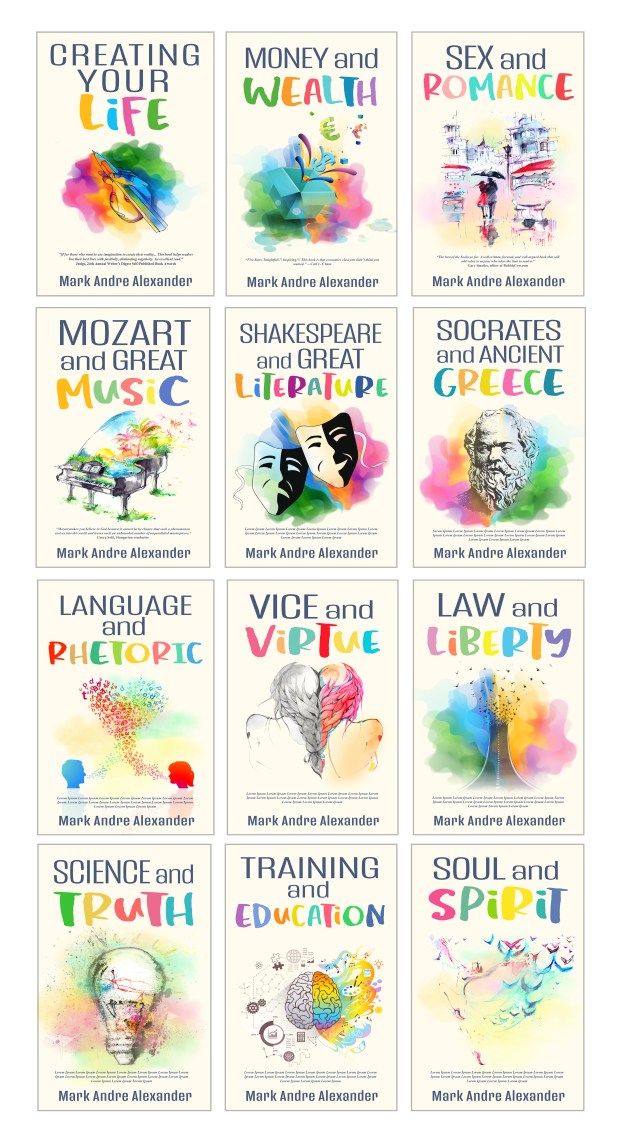
The Entire Series of Books

Here are the 12 covers of the books I am writing. I will be publishing some of the material to come on this blog so you can get a preview of the content. If you want to buy one of the available books from Amazon, click on the cover.

And by the way, all you need is an Amazon account and a computer. You don’t need a Kindle or iPad or other tablet. To download a free Kindle Reading App, just click on THIS LINK.

Mark Alexander collection3

Get FREE Podcasts, a 36-Day online course, and the Sex and Romance Checklist:
Join the Email List!